


1. Introduction
2. Materials and Methods
2.1. Study area, animals, and sampling
2.2. Greasy wool-yield determination
2.3. Wool-quality analysis and standards
2.4. Statistical analysis
3. Results and Discussion
3.1. Greasy wool yield
3.2. Wool composition
3.3. Hair diameter
3.4. Hair length
3.5. Sample preparation and impurity observations
3.6. Comparison with other breeds and previous studies
4. Conclusion
1. Introduction
Among the five traditional livestock species in Mongolia, sheep are one of the most important in terms of herd size and production output. The sheep sector accounts for nearly 40% of overall animal production, 60% of livestock exports, 55% of livestock meat production, 41% of domestic meat consumption, and 84% of wool production. The regional distribution of Mongolian sheep is highly variable: approximately 9% of herds are located in mountain areas, more than 20% in forest-steppe zones, more than 38% in steppe regions, and more than 20% in the Gobi Desert. More than 80% of the national sheep population consists of indigenous Mongolian (Khalkh) sheep, an important genetic resource developed through centuries of adaptation to Mongolia's harsh ecological and climatic conditions [1,2,3]. Mongolian sheep are widely recognized as a foundational breed distributed across the country and contributing to the development of numerous local and domestic sheep breeds with coarse, semi-fine, and fine wool. Mongolia also raises several breeds and breed groups, including Mongolian, Baidrag, Bayad, Gobi-Altai, Uzemchin, Sartuul, Darkhad, Barga, Sutai, Torguud, Buryat, and Tsagaan-Uul types [4,5,6,7,8,9,10]. The production value of raw wool depends strongly on fiber composition, fiber diameter, fiber length, impurity content, and greasy wool yield. Accurate evaluation of these indicators is therefore essential for assessing wool-production potential, improving raw-material preparation, and supporting breeding and selection activities [11,12,13,14,15,16]. The present study is also relevant to Mongolia's long-term policy documents, including Vision 2050 and strategies for genetic improvement of the five traditional livestock species. These policy directions emphasize nucleus-flock certification, scientifically grounded selection, more complete use of biological resources, climate-resilient livestock production, improvement of yield and product quality, and production of environmentally clean livestock products. Accordingly, this study aimed to determine the greasy wool yield and selected wool-quality indicators of Mongolian sheep raised in Erdenedalai soum, Dundgovi Province, and to compare the findings with previously reported data for Mongolian sheep and related sheep breeds.
2. Materials and Methods
2.1. Study area, animals, and sampling
The study was conducted in June 2025 in Erdenedalai soum of Dundgovi Province using sheep raised by herders in the Tsavchir, Tsagaan-Ovoo, Rashaan, and Sangiin Dalai baghs. Animals were randomly selected from breeding nucleus flocks representing the main age and sex groups: adult rams, ewes, ewe lamb, and ram lamb.
2.2. Greasy wool-yield determination
Greasy wool yield was determined by control shearing and direct measurement according to commonly used methodology. A total of 177 animals in medium or above-medium body condition were included: 64 ewes, 53 female yearlings, 30 male yearlings, and 30 adult rams. The results were compared with data reported by other researchers and with standards for coarse and semi-coarse wool sheep.
2.3. Wool-quality analysis and standards
For wool-quality determination, samples were prepared in accordance with applicable national standards. Representative body areas, including the shoulder or scapular region and the flank or side of the loin, were used for sampling. Laboratory analyses were conducted at the Wool Research Laboratory of the School of Animal Science and Biotechnology, Mongolian University of Life Sciences, and at the Cashmere Research Laboratory of the Livestock Research Institute.
The following Mongolian National Standards and standard procedures were applied: MNS 2951:2007, Wool and Cashmere - Sampling for Testing; MNS 2949:2008, Wool and Cashmere - Method for Determining Fiber Composition; MNS 2049:2001, Determination of Cashmere Content in Total Fiber; MNS 4034:2007, Method for Determining Wool and Cashmere Fiber Length; MNS 1000:2007, Methodology for Determining Wool and Cashmere Fiber Diameter; and MNS 1027:2007, Wool and Cashmere - Determination of Vegetable Matter and Impurities [11,12,13,14,15,16].
Fiber diameter was measured using an Optical Fibre Diameter Analyser (OFDA). Laboratory records included the date of analysis, sample identification number, unit of measurement in micrometers, operator name, and mean fiber-diameter value.
2.4. Statistical analysis
The numerical data were processed biometrically and are presented as mean ± standard error (M ± m), standard deviation (SD), and coefficient of variation (CV), where applicable. Descriptive comparisons were used to evaluate differences among age and sex groups and to compare the results with previously published breed data.
3. Results and Discussion
3.1. Greasy wool yield
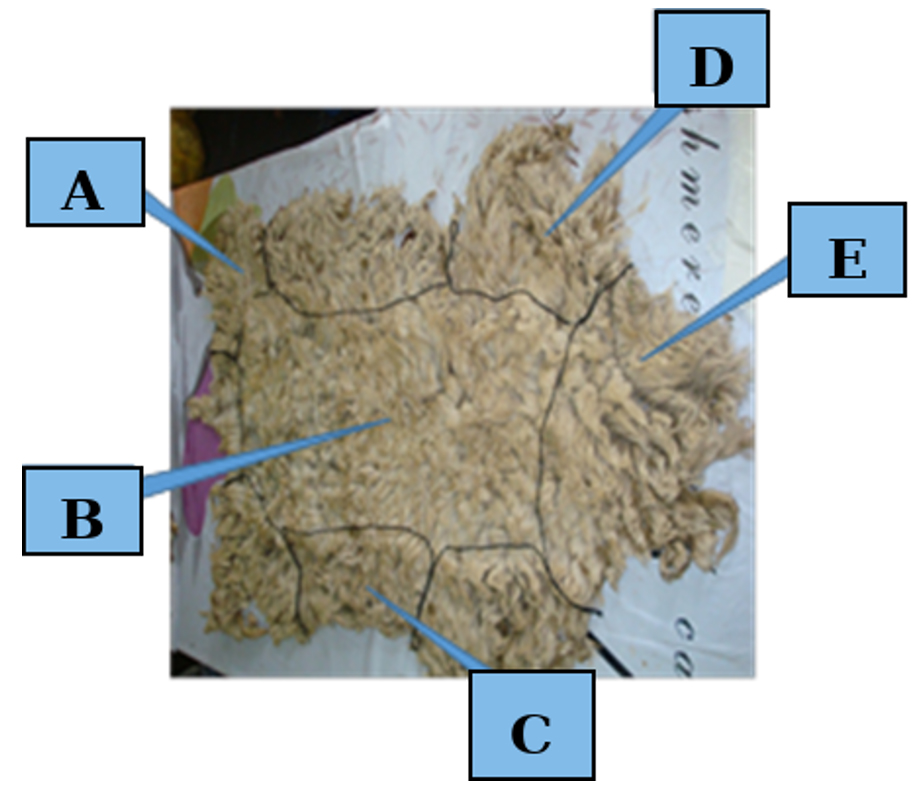
Greasy wool yield differed by age and sex (Table 1). Female yearlings produced an average of 1385.5 ± 14.6 g, whereas male yearlings produced 1470.8 ± 34.2 g. Ewes produced 1762.3 ± 15.5 g, and adult rams had the highest average yield at 1883.5 ± 51.6 g. These results indicate that greasy wool yield increases from the yearling groups toward the adult groups, particularly adult rams. Representative fleece sampling locations used for wool-quality analysis are shown in Figure 1.
Table 1.
Greasy wool yield of Mongolian sheep
3.2. Wool composition
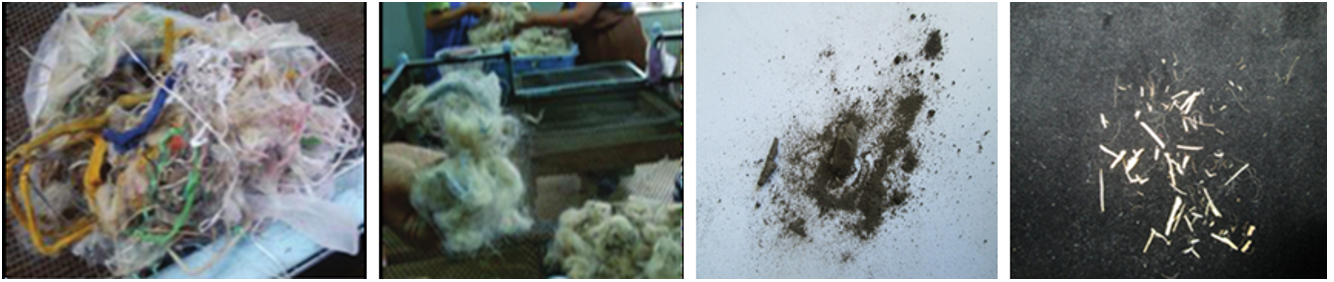
The wool structure and fiber composition of Mongolian sheep were determined by age and sex (Table 2). In ram lamb, the mean contents of Cashmere hair, intermediate hair, top hair, coarse hair were 38.37 ± 4.80%, 8.61 ± 3.23%, 27.18 ± 5.92%, and 27.10 ± 4.11%, respectively. Ewe lamb had 47.13 ± 4.41% Cashmere hair, 3.90 ± 0.67% intermediate hair, 21.22 ± 3.32% top hair, and 22.74 ± 1.83% coarse hair. Rams had 42.40 ± 3.06% Cashmere hair, 3.96 ± 0.69% intermediate hair, 20.47 ± 1.74% top hair, and 27.23 ± 2.71% coarse. Ewes had 38.83 ± 5.76% Cashmere hair, 4.20 ± 0.64% intermediate hair, 16.58 ± 4.08% top hair, and 34.57 ± 3.37% coarse hair. Examples of impurities identified during laboratory examination are presented in Figure 2.
Table 2.
Wool composition of Mongolian sheep, %
3.3. Hair diameter
Hair diameter was also determined by age and sex (Table 3). In ram lamb, cashmere hair diameter was 22.48 ± 0.19 µm, intermediate hair diameter 33.06 ± 0.53 µm, top hair diameter 42.20 ± 1.16 µm, and coarse hair diameter 46.13 ± 2.48 µm. In ewe lamb, the corresponding values were 22.30 ± 0.26 µm, 29.62 ± 0.28 µm, 40.74 ± 1.02 µm, and 42.71 ± 0.51 µm. Rams had cashmere hair, intermediate hair, top hair, and coarse hair diameters of 22.48 ± 0.67 µm, 33.48 ± 1.31 µm, 45.16 ± 1.30 µm, and 53.27 ± 0.86 µm, respectively. In ewes, the corresponding values were 22.42 ± 0.36 µm, 32.28 ± 1.24 µm, 39.85 ± 0.62 µm, and 43.15 ± 0.43 µm.
Table 3.
Hair diameter of Mongolian sheep wool, µm
3.4. Hair length
Hair length was examined for each age and sex group (Table 4). In ram lamb, cashmere length averaged 5.23 ± 0.36 cm and intermediate hair length averaged 6.17 ± 0.66 cm. In ewe lamb, cashmere length was 4.78 ± 0.08 cm and intermediate hair length was 5.62 ± 0.32 cm. In rams, cashmere length averaged 5.99 ± 0.35 cm and intermediate hair length averaged 6.79 ± 0.36 cm. In ewes, cashmere length was 5.35 ± 0.34 cm and intermediate hair length was 6.50 ± 0.30 cm.
Table 4.
Wool length of Mongolian sheep, cm
3.5. Sample preparation and impurity observations
Sample preparation and laboratory examination showed that the proportion of fine cashmere hair and their fineness are important determinants of wool-processing value. A higher proportion of cashmere hair and a lower hair diameter support the production of higher-quality spun and woven textile products. These results are therefore useful for evaluating raw-material quality, planning flock structure, and improving livestock-production efficiency.
Analysis of scurf and extraneous impurities revealed the presence of manure, soil, and woody plant materials in the wool samples. These contaminants were mainly associated with inadequate pre-shearing preparation, the use of polypropylene sacks for packing, and insufficient removal of manure residues during wool harvesting and packing. Consequently, mineral-based impurities were observed in the samples.
The proportion of scurf ranged from 0.13% to 0.17%, whereas the proportion of extraneous impurities ranged from 0.14% to 0.17%. These values indicate that vegetable matter and impurity levels in the samples were relatively low.
3.6. Comparison with other breeds and previous studies
The results of this study were compared with findings reported by other researchers on the wool productivity and quality of Mongolian sheep and other sheep breeds raised in Mongolia. Earlier studies by D. Choyjil and other researchers described the biological characteristics, body conformation, live weight, wool yield, and wool quality of local Mongolian sheep in several regions of Mongolia, including the Central, Eastern, South Gobi, Zavkhan, Govi-Altai, Khovd, and Uvs provinces [10, 17]. Wool yield of the studied sheep was compared with other Mongolian sheep breeds and breed groups (Table 5).
Table 5.
Comparison of wool yield in Mongolian sheep and other breeds
| Breed or breed group | Age and sex | Wool yield, kg |
| Bayad [18] | Ram | 2.20 |
| Bayad [18] | Ram lamb | 1.70 |
| Bayad [18] | Ewe | 1.80 |
| Bayad [18] | Ewe lamb | 1.50 |
| Darkhad [7] | Ram | 1.98 |
| Darkhad [7] | Ram lamb | 1.52 |
| Darkhad [7] | Ewe | 1.23 |
| Darkhad [7] | Ewe lamb | 1.20 |
| Torguud [5] | Ram | 2.84 |
| Torguud [5] | Ram lamb | 1.62 |
| Torguud [5] | Ewe | 1.43 |
| Torguud [5] | Ewe lamb | 1.14 |
| Tsagaan-Uul [19] | Ram | 2.07 |
| Tsagaan-Uul [19] | Ram lamb | 1.52 |
| Tsagaan-Uul [19] | Ewe | 1.71 |
| Tsagaan-Uul [19] | Ewe lamb | 1.41 |
| Mongolian, present study | Ram | 1.88 |
| Mongolian, present study | Ram lamb | 1.47 |
| Mongolian, present study | Ewe | 1.76 |
| Mongolian, present study | Ewe lamb | 1.39 |
Compared with the present Mongolian sheep population, Bayad sheep had higher wool yield in all listed groups: mature rams by 0.32 kg, yearling rams by 0.23 kg, ewes by 0.04 kg, and female yearlings by 0.11 kg. Darkhad mature rams and yearling rams were slightly higher by 0.10 kg and 0.05 kg, respectively, whereas Darkhad ewes and female yearlings were lower by 0.53 kg and 0.19 kg. Torguud mature rams and yearling rams were higher by 0.96 kg and 0.15 kg, whereas Torguud ewes and female yearlings were lower by 0.33 kg and 0.25 kg. Tsagaan-Uul mature rams, yearling rams, and female yearlings were higher by 0.19 kg, 0.05 kg, and 0.02 kg, respectively, whereas Tsagaan-Uul ewes were 0.05 kg lower than the ewes in the present study. Hair length characteristics were compared with those reported for other sheep breeds raised in Mongolia (Table 6).
Table 6.
Comparison of wool hair length in Mongolian sheep and other breeds
| Breed or breed group | Age and sex | Cashmere hair, cm | Top hair, cm | Intermediate hair, cm |
| Buryat [6] | Ram | 6.00 | 8.00 | - |
| Buryat [6] | Ewe | 6.00 | 9.00 | - |
| Buryat [6] | Ram lamb | 7.00 | 10.00 | - |
| Tsagaan-Uul [19] | Ram | 8.01 | 14.70 | - |
| Tsagaan-Uul [19] | Ram lamb | 7.40 | 11.36 | - |
| Tsagaan-Uul [19] | Ewe | 7.80 | 11.43 | - |
| Tsagaan-Uul [19] | Ewe lamb | 7.09 | 11.28 | - |
| Mongolian, present study | Ram | 5.99 | - | 6.79 |
| Mongolian, present study | Ram lamb | 5.35 | - | 6.50 |
| Mongolian, present study | Ewe | 5.23 | - | 6.17 |
| Mongolian, present study | Ewe lamb | 4.78 | - | 5.62 |
The down fiber length of the Mongolian sheep studied here was close to that of Buryat sheep in mature rams, differing by only 0.01 cm. It was shorter than that of Buryat sheep in ewes by 0.65 cm and in yearling rams by 1.77 cm. Compared with Tsagaan-Uul sheep, the present Mongolian sheep had shorter down fibers in all age and sex groups: by 2.02 cm in mature rams, 2.05 cm in ewes, 2.57 cm in yearling rams, and 2.31 cm in female yearlings. Thus, the down fiber length of the present population is generally closer to that reported for Buryat sheep than to that reported for Tsagaan-Uul sheep. Fiber diameter characteristics were compared with previously reported values for other Mongolian sheep breeds (Table 7).
Table 7.
Comparison of wool hair diameter in Mongolian sheep and other breeds
| Breed or breed group | Age and sex | Cashmere hair, µm | Top hair, µm | Intermediate hair, µm |
| Bayad [18] | Mature ram | 19.25 | 53.10 | 44.20 |
| Bayad [18] | Yearling ram | 18.99 | 48.34 | 39.30 |
| Bayad [18] | Ewe | 20.72 | 50.88 | 43.71 |
| Bayad [18] | Female yearling | 18.85 | 46.83 | 41.43 |
| Darkhad [7] | Mature ram | 20.20 | 63.50 | 40.10 |
| Darkhad [7] | Ewe | 20.10 | 60.20 | 40.50 |
| Darkhad [7] | Female yearling | 17.50 | 62.40 | 40.10 |
| Tsagaan-Uul [19] | Mature ram | 22.80 | 63.70 | 47.40 |
| Tsagaan-Uul [19] | Ewe | 21.20 | 58.50 | 45.40 |
| Tsagaan-Uul [19] | Yearling ram | 19.90 | 57.00 | 46.10 |
| Tsagaan-Uul [19] | Female yearling | 18.70 | 54.70 | 43.00 |
| Mongolian, present study | Mature ram | 22.48 | 45.16 | 33.48 |
| Mongolian, present study | Ewe | 22.42 | 39.85 | 32.28 |
| Mongolian, present study | Yearling ram | 22.48 | 42.20 | 33.06 |
| Mongolian, present study | Female yearling | 22.30 | 40.74 | 29.62 |
In comparison with Bayad sheep, the present Mongolian sheep had larger down fiber diameters: 3.23 µm higher in mature rams, 1.70 µm higher in ewes, 3.49 µm higher in yearling rams, and 3.45 µm higher in female yearlings. However, the present study showed lower guard and intermediate fiber diameters than Bayad sheep. In mature rams, guard fiber diameter was 7.94 µm lower and intermediate fiber diameter was 10.72 µm lower; in ewes, the corresponding differences were 11.03 µm and 11.43 µm; in yearling rams, 6.14 µm and 6.24 µm; and in female yearlings, 6.09 µm and 11.81 µm.
Compared with Darkhad sheep, the present Mongolian sheep had larger down fiber diameters but lower guard and intermediate fiber diameters. Darkhad down fibers were lower by 2.28 µm in mature rams, 2.32 µm in ewes, and 4.80 µm in female yearlings, whereas Darkhad guard fiber diameters were higher by 18.34 µm, 20.35 µm, and 21.66 µm, respectively. Darkhad intermediate fiber diameters were higher by 6.62 µm in mature rams, 8.22 µm in ewes, and 10.48 µm in female yearlings.
Compared with Tsagaan-Uul sheep, the present Mongolian sheep had a down fiber diameter 0.32 µm lower in mature rams but higher in ewes, yearling rams, and female yearlings by 1.22 µm, 2.58 µm, and 3.60 µm, respectively. Tsagaan-Uul sheep had substantially higher guard fiber diameters than the present Mongolian sheep: 18.54 µm higher in mature rams, 18.65 µm in ewes, 14.80 µm in yearling rams, and 13.96 µm in female yearlings. Their intermediate fiber diameters were also higher by 13.92 µm, 13.12 µm, 13.04 µm, and 13.38 µm in the same groups.
The hair composition of wool from the present Mongolian sheep population was compared with that of Mongolian sheep raised in other regions and with Tsagaan-Uul sheep (Table 8). In the Central region, cashmere hair content was 59.8% in rams, 61.2% in ewes, and 58.4% in ram lamb; intermediate fiber content was 5.6%, 4.3%, and 7.7%; top hair content was 25.3%, 27.3%, and 27.0%; and coarse hair content was 9.3%, 7.3%, and 7.0%, respectively. In the Western region, rams, ewes, and ram lamb had cashmere hair contents of 60.0%, 54.8%, and 55.9%, with intermediate hair contents of 12.0%, 11.8%, and 10.6%, top hair contents of 24.9%, 31.4%, and 31.5%, and coarse hair contents of 3.1%, 2.0%, and 2.0%.
Table 8.
Comparison of wool composition in Mongolian sheep and other regions or breeds, %
| Region, breed, or breed group | Age and sex | Cashmere hair | Intermediate hair | Top hair | Coarse hair |
| Central region [20] | Ram | 59.8 | 5.6 | 25.3 | 9.3 |
| Central region [20] | Ewe | 61.2 | 4.3 | 27.3 | 7.3 |
| Central region [20] | Ram lamb | 58.4 | 7.7 | 27.0 | 7.0 |
| Western region [20] | Ram | 60.0 | 12.0 | 24.9 | 3.1 |
| Western region [20] | Ewe | 54.8 | 11.8 | 31.4 | 2.0 |
| Western region [20] | Ram lamb | 55.9 | 10.6 | 31.5 | 2.0 |
| Eastern region [20] | Ram | 62.1 | 4.6 | 24.5 | 8.8 |
| Eastern region [20] | Ewe | 54.8 | 11.8 | 31.4 | 2.0 |
| Eastern region [20] | Ram lamb | 55.9 | 10.6 | 31.5 | 2.0 |
| Tsagaan-Uul [19] | Ram | 58.87 | 13.55 | 17.37 | 5.81 |
| Tsagaan-Uul [19] | Ewe | 62.08 | 13.16 | 15.45 | 4.78 |
| Tsagaan-Uul [19] | Ram lamb | 60.48 | 13.37 | 16.34 | 5.38 |
| Tsagaan-Uul [19] | Ewe lamb | 63.71 | 13.01 | 14.52 | 4.37 |
| Mongolian, present study | Ram | 42.40 | 3.96 | 20.47 | 27.23 |
| Mongolian, present study | Ewe | 38.83 | 4.20 | 16.58 | 34.57 |
| Mongolian, present study | Ram lamb | 38.37 | 8.61 | 27.18 | 27.10 |
| Mongolian, present study | Ewe lamb | 47.13 | 3.90 | 21.22 | 22.74 |
In the Eastern region, adult rams had 62.1% cashmere hair, 4.6% intermediate hair, 24.5% top hair, and 8.8% coarse hair. Ewes and ram lamb in the Eastern region were reported with 54.8% and 55.9% cashmere hair, 11.8% and 10.6% intermediate hair, 31.4% and 31.5% top hair, and 2.0% coarse hair. Tsagaan-Uul sheep had higher cashmere hair content than the present Mongolian sheep in all comparable groups: 58.87% in rams, 62.08% in ewes, 60.48% in ram lamb, and 63.71% in ewe lamb. By contrast, the present Mongolian sheep had a higher proportion of coarse hair, especially in ewes at 34.57%, confirming the coarse-wool character of the studied population.
Previous studies have reported that first-grade wool contains approximately 54.1% cashmere hair, 4.6% intermediate hair, 33.2% top hair, and only a negligible proportion of coarse hair. Second-grade wool has been reported to contain 46.0% cashmere hair, 11.5% top hair, 3.1% intermediate hair, and 39.3% coarse hair, whereas third-grade wool contains approximately 42.8% cashmere hair and 46.1% coarse hair [5, 18, 20, 21]. The wool composition of the present population falls within the range of coarse-wool characteristics reported in earlier studies. Because recent comparative studies of Mongolian sheep wool quality by age and sex are limited, the present findings provide useful baseline information for breeding, selection, grading, and raw-wool preparation.
4. Conclusion
When greasy wool yield was determined by age and sex, ewe lamb produced 1385.5 ± 14.6 g (1.39 ± 0.015 kg), ram lamb produced 1470.8 ± 34.2 g (1.47 ± 0.034 kg), ewes produced 1762.3 ± 15.5 g (1.76 ± 0.016 kg), and rams produced 1883.5 ± 51.6 g (1.88 ± 0.052 kg).
The wool composition of the studied sheep confirmed a coarse-wool type. Cashmere hair content was 38.37 ± 4.80% in ram lamb, 47.13 ± 4.41% in ewe lamb, 42.40 ± 3.06% in rams, and 38.83 ± 5.76% in ewes. Intermediate hair content was 8.61 ± 3.23%, 3.90 ± 0.67%, 3.96 ± 0.69%, and 4.20 ± 0.64%; top hair content was 27.18 ± 5.92%, 21.22 ± 3.32%, 20.47 ± 1.74%, and 16.58 ± 4.08%; and coarse hair content was 27.10 ± 4.11%, 22.74 ± 1.83%, 27.23 ± 2.71%, and 34.57 ± 3.37% in the same groups, respectively.
Cashmere hair length was 5.23 ± 0.36 cm in ram lamb, 4.78 ± 0.08 cm in ewe lamb, 5.99 ± 0.35 cm in rams, and 5.35 ± 0.34 cm in ewes. Intermediate hair length was 6.17 ± 0.66 cm, 5.62 ± 0.32 cm, 6.79 ± 0.36 cm, and 6.50 ± 0.30 cm in the same groups. These values are generally close to previously reported results for Mongolian sheep.
Cashmere hair diameter was relatively similar across the studied groups, ranging from 22.30 to 22.48 µm. Intermediate hair diameter ranged from 29.62 to 33.48 µm, top hair diameter from 39.85 to 45.16 µm, and coarse hair diameter from 42.71 to 53.27 µm.
Scurf and extraneous impurity levels were low, with scurf ranging from 0.13% to 0.17% and extraneous impurities from 0.14% to 0.17%. Proper pre-shearing preparation, cleaning, and packaging remain important for reducing mineral and plant contamination in wool.
The results provide practical baseline information for evaluating Mongolian sheep wool productivity, organizing breeding and selection work, improving wool grading by age and sex, and supporting processing technologies for coarse-wool products such as carpets and felt.

