


1. Introduction
2. Materials and Methods
2.1. Ethical statement
2.2. Sample collection
2.3. DNA extraction
2.4. PCR-RFLP analysis
3. Results and Discussion
4. Conclusions
1. Introduction
Sheep are among the most important livestock species worldwide, providing meat, wool, milk, and other products essential for human livelihoods. In Mongolia, sheep husbandry plays a central role in the agricultural sector and contributes significantly to the national economy. Indigenous Mongolian sheep breeds are well adapted to harsh climatic conditions, extensive grazing systems, and seasonal feed shortages, making them valuable genetic resources for sustainable livestock production.
Meat production is a primary objective of sheep breeding programs. Increasing consumer demand for high-quality lamb and mutton has emphasized the need to improve growth performance, carcass yield, and meat quality. However, these traits are quantitative and are influenced by multiple genetic and environmental factors.
Advances in molecular genetics have enabled the identification of genes associated with economically important traits in livestock [1]. Molecular markers are widely used to assess genetic diversity and support marker-assisted selection in breeding programs. Identification of functional genes involved in muscle development and carcass composition allows more efficient genetic improvement.
Among candidate genes, the callipyge (CLPG) gene is one of the most extensively studied in sheep. The callipyge mutation, first identified in Dorset sheep, results from a single nucleotide polymorphism (A→G transition) located on ovine chromosome 18 (OAR18) within the DLK1–GTL2 imprinted gene cluster [2,3]. This mutation is associated with muscle hypertrophy, increased carcass yield, and reduced fat deposition. It exhibits a unique inheritance pattern known as polar overdominance, in which the phenotype is expressed only in specific heterozygous individuals inheriting the mutant allele from the sire.
The frequency of the CLPG mutation varies among sheep breeds. While commercial breeds such as Dorset, Hampshire, and Rambouillet may carry the mutant allele, many indigenous and locally adapted breeds are monomorphic for the wild-type allele [2,4,5]. These differences suggest that breed origin and selection history strongly influence the distribution of the mutation.
Despite the economic importance of sheep production in Mongolia, molecular information on key production-related genes remains limited. In particular, data on CLPG gene variation in Mongolian sheep breeds are scarce. To the best of our knowledge, no previous study has investigated CLPG polymorphism across multiple Mongolian sheep breeds using PCR-RFLP analysis.
Therefore, this study aimed to investigate CLPG gene polymorphism in seven Mongolian sheep breeds using PCR-RFLP analysis and to screen for the presence of genetic variation at this locus.
2. Materials and Methods
2.1. Ethical statement
This study was reviewed and approved by the Ethics Committee of the Mongolian University of Life Sciences (Approval number: VSBMR-2025/014) on April 15, 2025.
2.2. Sample collection
A total of 338 blood samples were collected from seven Mongolian sheep breeds (Table 1 and Fig. 1). Approximately 3 mL of blood was collected from the jugular vein of each animal into vacuum tubes containing ethylenediaminetetraacetic acid (EDTA) as an anticoagulant. The samples were transported to the laboratory for subsequent genomic DNA extraction.
Table 1.
Indigenous Mongolian sheep breeds and sampling locations used in this study
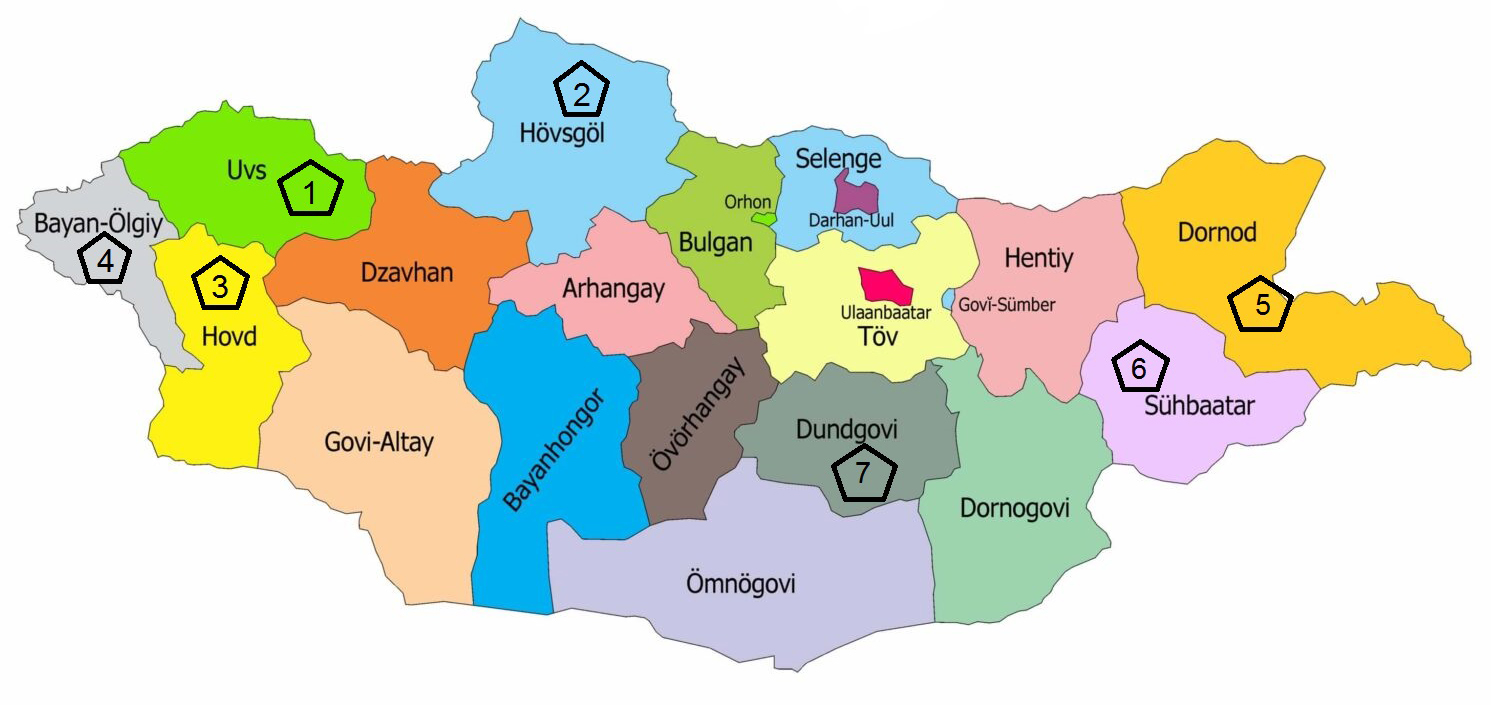
Fig. 1
Geographic locations of sheep breed sampling sites in Mongolia. The numbered locations indicate the sampling sites of indigenous Mongolian sheep breeds: (1) Bayad breed, sampled from Zuun Gobi Soum, Uvs Province; (2) Tsagaan-Uul breed, sampled from Tsagaan-Uul Soum, Khuvsgul Province; (3) Torguud breed, sampled from Bulgan Soum, Khovd Province; (4) Kerei breed, sampled from Deluun Soum, Bayan-Ulgii Province; (5) Barga breed, sampled from Khulunbuir Soum, Dornod Province; (6) Uzemchin breed, sampled from Erdenetsagaan Soum, Sukhbaatar Province; and (7) Mongolian native sheep, sampled from Erdenedalai Soum, Dundgovi Province.
2.3. DNA extraction
Genomic DNA was extracted from whole blood samples using the AccuPrep Genomic DNA Extraction Kit (Bioneer, Republic of Korea) according to the manufacturer’s instructions. DNA concentration and purity were measured using an ND-8000 UV-Vis spectrophotometer (NanoDrop Technologies, Wilmington, DE, USA). To improve DNA quality and yield, an additional ethanol precipitation step was performed following the initial extraction. Purified DNA samples were stored at –20°C until further analysis.
2.4. PCR-RFLP analysis
PCR amplification of the CLPG gene was performed using a SimpliAmp™ Thermal Cycler (Applied Biosystems, Foster City, CA, USA) in a total reaction volume of 10 µL, containing 4 µL genomic DNA, 0.4 µL of each primer, 5 µL of 2 x Red Taq DNA Polymerase Master Mix (1.5 mM MgCl₂), and nuclease-free water to adjust the final volume.
The primer sequences were as described by Freking et al. [6]: forward primer, 5′-TGA AAA CGT GAA CCC AGA AGC-3′; reverse primer, 5′-GTC CTA AAT AGG TCC TCT CG-3′. The PCR conditions consisted of an initial denaturation at 94°C for 4 min, followed by 35 cycles of denaturation at 94°C for 20 s, annealing at 58°C for 30 s, and extension at 72°C for 1 min, with a final extension at 72°C for 10 min. The reaction was then held at 4°C.
PCR products were separated by electrophoresis on 2% (w/v) agarose gel. Genotypes were determined using restriction fragment length polymorphism (RFLP) analysis. PCR products were digested in a 10 µL reaction mixture containing 6 µL PCR product, 2.5 µL nuclease-free water, 0.5 µL restriction enzyme BsmFI (New England BioLabs), and 1 µL enzyme buffer. Digestion was performed at 65°C for 1 h in a water bath. The resulting fragments were separated on 2% agarose gel in 1xTBE buffer and visualized under UV light.
Genotype and allele frequencies were calculated using Microsoft Excel 2016.
3. Results and Discussion
PCR-RFLP analysis of the CLPG gene revealed only a single genotype AA across all 338 examined Mongolian sheep. The restriction digestion patterns corresponded exclusively to the wild-type allele, and no mutant G allele was detected (Fig. 2 and Fig.3). The detailed genotype and allele frequencies for each of the seven indigenous breeds are presented in (Table 2). The observed genotype frequency of AA was 1.00, indicating complete monomorphism at the CLPG locus in the studied population.
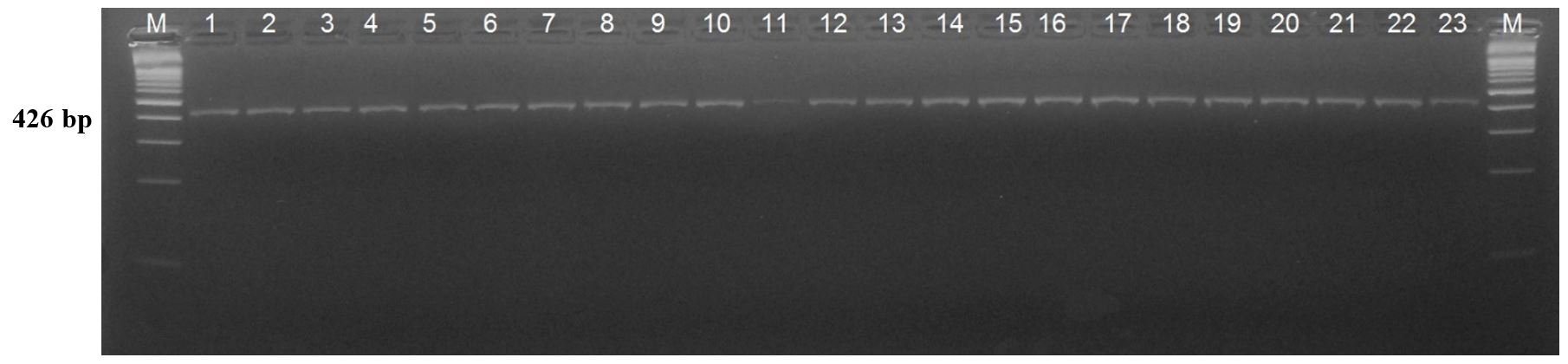
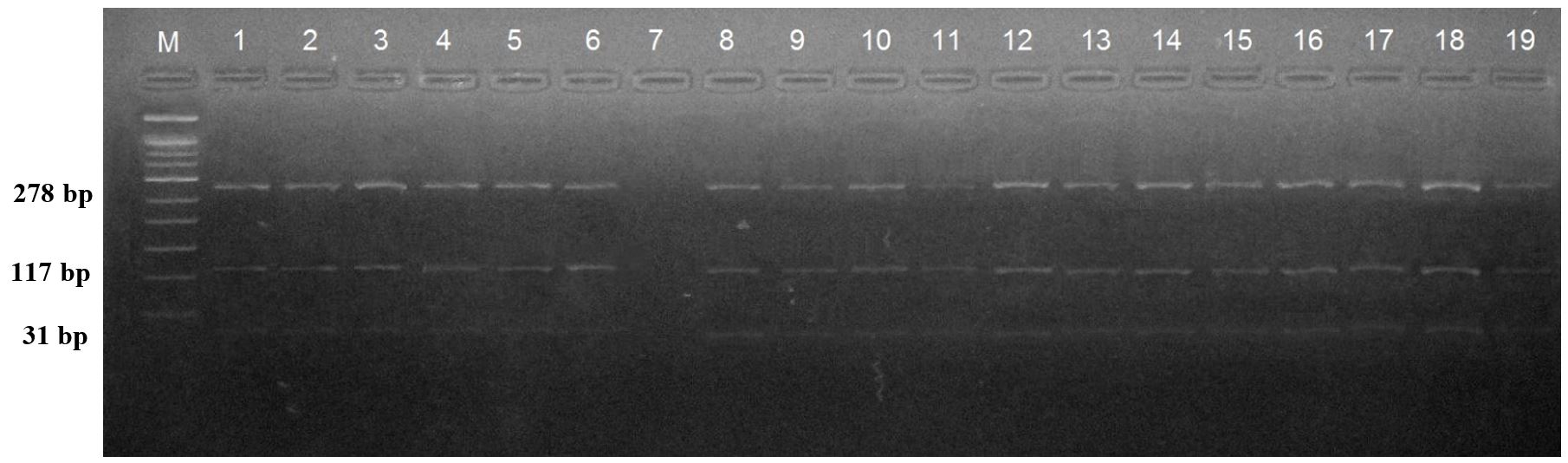
Fig. 3
Electropherogram of the PCR-RFLP result of the CLPG/BsmFI locus in 2% agarose gel. Lane M: 50 bp DNA ladder; Lanes 1-3: Mongol breed; Lanes 4-6: Uzemchin breed; Lanes 7-9: Barga breed; Lanes 10-12: Tsagaan-Uul breed; Lanes 13-15: Bayad breed; Lanes 16-17: Kerei breed; Lanes 18-19: Torguud breed.
Table 2.
Allele and genotype frequencies of the CLPG locus in Mongolian sheep breeds
| No. | Population | n | Allele frequency | Genotype frequency | |||
| A | G | AA | AG | GG | |||
| 1 | Bayad | 43 | 1.00 | 0.00 | 1.00 | 0.00 | 0.00 |
| 2 | Tsagaan-Uul | 50 | 1.00 | 0.00 | 1.00 | 0.00 | 0.00 |
| 3 | Torguud | 41 | 1.00 | 0.00 | 1.00 | 0.00 | 0.00 |
| 4 | Kerei | 42 | 1.00 | 0.00 | 1.00 | 0.00 | 0.00 |
| 5 | Barga | 49 | 1.00 | 0.00 | 1.00 | 0.00 | 0.00 |
| 6 | Uzemchin | 45 | 1.00 | 0.00 | 1.00 | 0.00 | 0.00 |
| 7 | Mongol | 50 | 1.00 | 0.00 | 1.00 | 0.00 | 0.00 |
| Average | 338 | 1.00 | 0.00 | 1.00 | 0.00 | 0.00 | |
Only the A allele was detected, with an allele frequency of 1.00. Because the locus was completely monomorphic, evaluation of the Hardy-Weinberg equilibrium was not applicable. These findings confirm the absence of genetic variation at the CLPG locus in the examined sheep breeds.
Similar monomorphic patterns have been reported in several sheep populations worldwide. Gabor et al. [4] observed only the AA genotype in Lacaune, Tsigai, Improved Valachian, and East Friesian sheep. Likewise, monomorphism has been reported in Lori sheep from Iran [7], Najdi and Harri sheep from Saudi Arabia [8], and several Indian and Russian sheep breeds [5,9]. Similar findings were also reported in the Karakachan sheep breed, where PCR-RFLP analysis of the CLPG gene detected only the AA genotype and A allele, indicating complete monomorphism at this locus [10]. Collectively, these results indicate that the wild-type A allele is predominant in many indigenous and locally adapted sheep populations.
In contrast, polymorphism at the CLPG locus, including the presence of the mutant G allele, has been reported in commercial breeds such as Dorset, Rambouillet, and Hampshire sheep [2,3]. The callipyge mutation has been reported to be associated with postnatal muscle hypertrophy, increased lean meat yield, particularly in the hindquarters, and changes in carcass traits in those specific genetic backgrounds.
The absence of the mutant allele in the present study may be related to the genetic background and breeding history of Mongolian sheep. These breeds have been developed under extensive grazing systems, where natural selection for environmental adaptation, survivability, and hardiness has been more important than intensive selection for carcass traits. Consequently, alleles associated with enhanced muscling may not have been introduced or maintained in these populations.
Although the CLPG gene has been investigated as a candidate gene related to growth and carcass traits in some sheep populations [11,12], the present study indicates that no inference regarding its association with meat production traits can be made in Mongolian sheep due to the absence of genetic variation at this locus. Therefore, further studies involving larger populations and additional candidate genes related to growth, carcass composition, and meat quality are required.
Overall, this study provides molecular evidence of complete monomorphism at the CLPG locus in Mongolian sheep breeds, contributing to baseline information on genetic variation in indigenous sheep populations.
4. Conclusions
This study investigated the polymorphism of the CLPG gene in 338 individuals across seven indigenous Mongolian sheep breeds using PCR-RFLP analysis with the BsmFI restriction enzyme. The target 426 bp PCR product was successfully amplified in all samples. Genotyping results revealed exclusively the homozygous wild-type AA genotype and a 1.00 allele frequency for the A allele, indicating complete monomorphism at this locus. The absence of heterozygous AG or homozygous mutant GG genotypes demonstrates that the callipyge mutation is not present in the studied indigenous Mongolian sheep populations, indicating that no genetic variation was detected at the CLPG locus in these breeds.

